 |
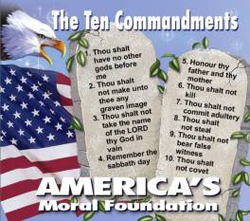
| The Ten Commandments of Moses |
Ten Commandments of Moses
The Ten Commandments in the Bible were given to us by Moses
Deuteronomy 5:29
O that there were such an heart in them, that they would fear me, and keep all my commandments always, that it might be well with them, and with their children for ever! Will the Commandments apply for ever, or Old Testament time only
Psalm 111
7 The works of his hands are verity and judgment; all his commandments are sure.
8 They stand fast for ever and ever, and are done in truth and uprightness.
9 He sent redemption unto his people: he hath commanded his covenant for ever: holy and reverend is his name.
10 The fear of the LORD is the beginning of wisdom: a good understanding have all they that do his commandments: his praise endureth for ever.
Law of Moses, The Covenant
1 Chronicles 16
15 Be ye mindful always of his covenant; the word which he commanded to a thousand generations;
17 And hath confirmed the same to Jacob for a law, and to Israel for an everlasting covenant,
Deuteronomy 7:9
Know therefore that the LORD thy God, he is God, the faithful God, which keepeth covenant and mercy with them that love him and keep his commandments to a thousand generations;
The Commandments Covenant
Exodus 34:28
28 And he was there with the LORD forty days and forty nights; he did neither eat bread, nor drink water. And he wrote upon the tables the words of the covenant, the ten commandments.
Septuagint
The Septuagint derives its name from the Latin septuaginta, 70, hence the abbreviation LXX and from a legendary account in the "Letter of Aristeas" of how seventy-two Jewish scholars (six scribes from each of the twelve tribes) were asked by the Egyptian pharaoh Ptolemy II Philadelphus in the 3rd century BC to translate the Torah for inclusion in the Library of Alexandria. In a later version of that legend narrated by Philo of Alexandria, although the translators were kept in separate chambers, they all produced identical versions of the text in seventy-two days. Although this story is widely viewed as implausible today, it underlines the fact that some ancient Jews wished to present the translation as authoritative. A version of this legend is found in the Talmud, which identifies 15 specific unusual translations made by the scholars. Only 2 of these translations are found in the extant LXX. The names "Septuagint" and "LXX" are of later Latin origin and are not used in Greek. The Septuagint version is very close in wording to the King James Version KJV. See it: SeptuagintMoses
Law of Moses This is a Biblical perspective. Moses To see what Moses wrote:Council of Chalcedon
At this council held in 451 AD, leaders of the Church affirmed the basics of our Christian faith, including the Trinity. A creed was written. Today, many associate Chalcedon with those who follow the word of God, the complete Old and New Testaments, and the following of the moral law of Moses. Chalcedon For the ultimate web site of information, Sunday School Literature, articles, and Bible Study,Ten Commandments court victory in Mercer County, Kentucky
From WorldNetDaily: A U.S. appeals court upholds a decision in favor of Ten Commandments display in the Courthouse of Kentucky. How will this effect the governors race in Kentucky? Kentucky Governor Steve Beshear, is up for reelection. If 2011 is an indicator, the reelection of the Democratic Governor will be a tough battle. Kentucky Governor Candidates See list of Kentucky governor candidates.
The 2012 Candidates for President Candidate Information
Ron Paul believes in the Moral Laws of Moses:Ron Paul for President in 2012
Republican Ron Paul for President
Ron Paul News for President
Herman Cain, great speaker, but he was pro abortion in his past life.
Herman Cain for President Quotes
Republican Herman Cain for President in 2012 How about sweet Sarah Palin, read her interesting quotes at: Quotes of Sarah Palin for President 2012
Mitt Romney as Governor has done more to promote the pro gay and pro abortion agenda, more than all of the candidates for president in 2012. Read about the positions of the candidates for president at: The 2012 Tea Party Candidates for President
Apostolic Bible Polyglot - interlinear Septuagint and Greek New Testament
Meaning of the 8th Commandment
Why Should a Christian Buy Life Insurance
Is Buying Life Insurance Biblical?
Ten Commandments of Moses from the Bible brings you these weekly Bible verses.
Exodus 9:8-12
8 Then the Lord said to Moses and Aaron, “Take handfuls of soot from a furnace and have Moses toss it into the air in the presence of Pharaoh.
9 It will become fine dust over the whole land of Egypt, and festering boils will break out on people and animals throughout the land.”
10 So they took soot from a furnace and stood before Pharaoh. Moses tossed it into the air, and festering boils broke out on people and animals.
11 The magicians could not stand before Moses because of the boils that were on them and on all the Egyptians.
12 But the Lord hardened Pharaoh’s heart and he would not listen to Moses and Aaron, just as the Lord had said to Moses.
1271 Eastland Rd.
Sparta, TN 38583
Telephone: 931-935-2110
Email:

Type email address, it will not copy.